DMS Talks
Designed to perform better – Experience Design in Retail.
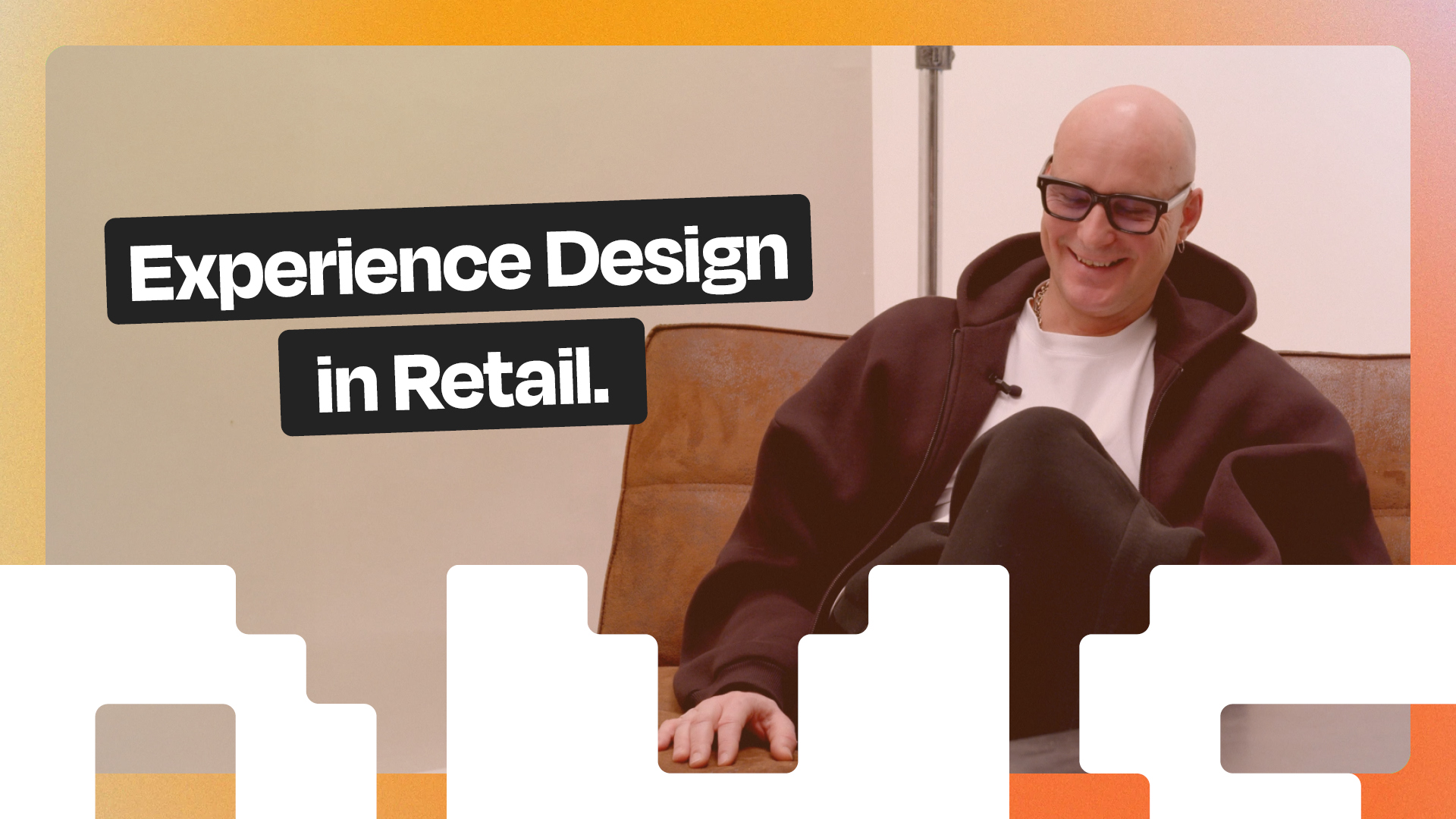
With Franz Riebenbauer, Founder of Studio Riebenbauer, we welcome another high-profile guest and retail expert to the DMS Talk. For us, this conversation is a unique experience: few people can provide such compelling insights into the interaction of brand, space, product, and digitalization as Franz Riebenbauer. In conversation with Oliver Nitz, CMO of DMS, he reflects on his career in the creative industry and the experiences that shaped him into an interdisciplinary thinker. We sincerely thank him for his time and his valuable insights.
Making Brands Tangible Through All the Senses – An Experience That Lasts
Creating something truly unique has always been Franz Riebenbauer’s ambition. He began his career in advertising as an Art Director at the renowned agency Jung von Matt in Hamburg, where strong conceptual ideas formed the core of every solution. Today, he is internationally recognized as a mastermind in strategy, architecture, graphic design, product design, and creative direction. Who says creativity must focus on a single industry? Certainly not Franz Riebenbauer, whose architecturally outstanding projects are as impressive as his distinctive creative concepts in advertising.
All in One. All Perfect.
That creativity knows no boundaries is evident in his holistic, multisensory brand approach. Together with his team, Franz Riebenbauer aims to create seamless brand experiences across all touchpoints — forming a true symbiosis of digital and physical experience. This is a credo we also live by at DMS: we think digital, but never digital only. We ensure that our digital solutions integrate perfectly into physical spaces while maintaining the highest aesthetic standards — a mindset we share with Franz Riebenbauer. Only when every component is perfectly aligned can a true “wow” experience emerge. And that is exactly what we strive for in every project.
Boundless Creativity
This goes beyond the interdisciplinary way of thinking and working for which Franz Riebenbauer is known far beyond national borders. Through his work in Vienna and Los Angeles with Studio Riebenbauer, he successfully combines European design sensibility with bold American brand building, making both fully tangible. While the strength of the U.S. lies in scaling brands, it often comes with a lesser focus on detail culture. Here, Franz Riebenbauer sees European precision and refinement as a valuable differentiator — a perspective he shares in the DMS Talk.
Brand-New Brand News: Experience Design as a Game Changer
Continuous innovation and constant evolution are essential in retail — because the industry has fundamentally transformed. As products are digitally available at any time, the primary purpose of visiting a store today is the experience. Stores become unique brand stages: when digital and physical touchpoints seamlessly converge, the store turns into a true Point of Experience.
A Case to Remember: Biogena as a Health and Lifestyle Trend Brand
Consumers’ willingness to invest in health and wellbeing is nothing new — Biogena’s solutions are. From the Experience Tunnel in Salzburg, featuring AI-based aura analysis and sensory evaluations of temperature and skin tones, to its role as the entrance to a groundbreaking 24/7 digital store, Biogena sets new standards. Automated product dispensing, smart logistics behind the screens, and flexible pickup and shipping options simplify the shopping journey. Biogena thus delivers not only premium micronutrients, but also a top-level customer experience.
A Conversation That Keeps Us Talking
In the DMS Talk, Oliver Nitz raises essential questions:
How does a typical project at Studio Riebenbauer begin — with the brand, the space, or the experience? How important is the interplay of content, technology, and spatial design? Which technological and design trends will shape experience design in the coming years?
Franz Riebenbauer answers with the competence, creativity, and openness that make him a trusted partner among clients and colleagues alike. He emphasizes the need for courage, a willingness to abandon familiar patterns, and radical thinking. When it comes to digital technologies, the focus must always be on added value: digital touchpoints must be interactive, and displays should be more than “digital posters.” Data enables personalized experiences and a more relevant retail environment. Screens without interaction often lack relevance — and therefore fail to inspire. And that is exactly what retail is about: inspiring people.
Modern Talking in Retail – What’s Next?
For experience design to remain successful, augmented reality deserves greater attention, with multidimensional content taking center stage. Robotics, too, will soon play a convincing role — from large-scale installations to micro-robotics.
What’s Next? One Thing Remains: A Future Skill with a Past
As much as retail continues to evolve, success requires more than technological expertise alone. The future skill that has proven its value time and again is authenticity. “Only those who create something truly unique can stand out from the crowd,” says Franz Riebenbauer. And: “The concept must fit the brand.” Empty spectacle does not work sustainably — uniqueness does.
Experience the Excellence: With DMS and Studio Riebenbauer
Our recommendation: experience excellence firsthand in the DMS Talk — and discover how it enables better retail performance. For us, the conversation was a valuable learning experience and another opportunity to grow through exchange with an outstanding expert. We will integrate these insights into our future projects across digital signage, retail and customer analytics, in-store radio, and beyond. Our goal remains the same as Franz Riebenbauer’s in every case: to inspire. True to our credo — if it’s not wow, it’s not DMS.
We thank Franz Riebenbauer for the inspiring conversation and wish all viewers one thing above all: enjoy the stream.
Please note: this talk is available in the German language only.
Welcome to the DMS Talk. My name is Oliver Nütz. I am the moderator today.
Our topic today: brand, space and digital. How does experience design in retail emerge?
My guest today, Franz Rebenbauer, sitting next to me, is founder and managing director of Studio Rebenbauer. And I have brought along a few questions with which we will take a closer look at the topic.
Dear Franz, thank you for your time. I have read and learned that you come from advertising. Is that correct?
That is correct, yes. Many years ago I started in advertising, in Germany at Jung von Matt. I learned a lot there and that is certainly one reason why the conceptual idea is still the foundation of every solution we develop.
What did you do in advertising?
What did I do in advertising? Jung von Matt founded, headcount around, at most 30 people at that time in Hamburg. Campaigns for Porsche, Audi, BMW. Yes, advertising. Completely classic: films, print ads. The way one knows it. The way the world no longer is today. And I worked there as a creative, started within the company as a graphic designer and had the chance to learn a great deal.
They were already well known, I think. Today they are probably very well known in the German-speaking region. What do you do today?
What do I do today? Today we make brands globally experienceable with all senses. Basically, we work extremely across genres. Starting from the conceptual idea, we actually address every layer that a brand should address. We really try to create a holistic, sensory experience.
Studio Rebenbauer stands for Brand, Space, Product, Digital and Experience Design. How would you describe your DNA?
We would describe our DNA like this: our DNA is basically that we bring brands to life with all senses. And I believe what distinguishes us from many studios and agencies is that we work extremely across disciplines. That means a team with us consists of strategists, graphic designers, architects, product designers and digital experts. That means we really try to address every single point that is important for a brand and to think interdisciplinarily within a group. They think together, they come together to solutions.
And that is how a seamless experience emerges, which probably not many studios worldwide can offer. So an examination of what works at the touchpoint, including digitally?
Exactly. What works analog? Exactly. So it is about the analog touchpoints, from smell through to the digital experience or user journey. Connecting the analog with the digital experience is essential. Because we live on the one hand in a digital world and on the other hand in an analog world.
And combining these two to create a unique brand experience is essential. And whoever does not do that, will then be successful? No. And that is actually your specialty.
That is our specialty, yes.
Okay, cool. How has your market expansion developed? How has this work developed? Are there significant differences between Vienna and L.A.? Approaches to projects or approaches on the customer side? Are the customers different?
The customers are different. I believe there are naturally large socio-cultural differences between Americans and Europeans. And what we combine with each other now in America and also in South America is what we call European design sensibility with bold American brand building.
Americans know how to create a brand, how to scale a brand and make it big. Probably no other country in the world can do that better. That is the reason why they are so strong, why they have produced so many global brands. What they lack, however, is the sensitivity, the love for detail.
And because we combine both, we also have quite a good standing in America by now.
What does experience design mean to you in the context of retail and brand communication?
In retail, you first have to start with the question: what is retail today? Something where you say, okay, you go there, there are all the products and then you buy the products there. That is no longer the case today. Today I can buy any product just as well digitally.
So what is the reason why you go into a store? Certainly not just to buy a product. In a retail store it is about the experience. And the experience has to be analog on the one hand, but digital on the other.
There is one of the best-known Chinese retail scientists who said: “The future of e-commerce is brick and mortar.” That means the shops of today are there to convey the attitude of a brand, to make the brand experienceable. Whether I buy there or not is secondary for modern retail concepts. I can just as well buy digitally.
What is the reason why I go there, look at the shop, see what happens with the products there? The same experience then happens digitally. The product is sent to me or I take it with me. Why carry it around? You can just as well have it shipped.
This expands the analog store digitally. And when I merge these two things, that is of course the best solution.
It goes as far as having a screen in the fitting room where I can select another size, complete the ordering process and the payment process. Who still needs a cash desk? In America this is no longer legally required. I can just as well pay in the fitting room and then implement a system that either unlocks the product if I take it with me or automatically ships it digitally.
I log into my profile and that’s it.
Okay, and if it doesn’t fit after all, I can send it back.
Exactly.
And of course that also makes the entire logistics in retail, analog as well as digital, better and easier. That means the spaces are no longer intended for backrooms, but really only for the experience. You no longer need backrooms.
And that is of course great. So a physical location so that the brand has an effect.
Yes, exactly.
That is quite interesting. I recently had Kurt Stephan here, the founder and co-owner of Veletage, a bicycle store in Vienna, whom I like very much. And he also said he calls it brick-and-mortar media.
Yes, exactly.
Basically the brand’s own mediation performance. We are in the brand and show people that you can go there. We go someone.
That’s how it is.
I believe in a bicycle store it is a bit different, because it is a more complex product. But clothing and so on, yes, yes, I believe that as well.
Yes, you have already answered my good question. Are there projects with you where brand and digital in space interact particularly well, in your opinion?
Yes, I believe Biogena is such a case. We have implemented brand spaces on every continent. It is really only about engaging with the brand. Biogena does something in Salzburg – they have their origins in Salzburg – and there, directly behind the Getreidegasse, which is not exactly a futuristic shopping street but a baroque building, we built an experience tunnel lined with craft monitors.
There is a KI aura analysis taking place there. Based on body temperature, whether you have cooler skin tones, whether you are sweaty or not, different color gradients are automatically played. And this algorithm or this AI learns with every person who passes through.
This creates a massive experience that makes this welcome diversity and what was once Biogena’s world of life – this transformation, this “I find myself, I change myself, I optimize myself” – experienceable.
It’s fun for people, I assume.
Yes. The gender average is very high. And that is because you can only enter the space by passing through this tunnel. You cannot bypass it or anything, you have to go through it.
Yes.
And I think that is relatively unique.
And then we also developed a digital store. For every Biogena bubble there is also a 24-hour access where I can, of course, buy every product via digital self-services and have it sent there, for example. Then I pick it up there.
Ah, okay.
Behind each of these monitors there is a robotic system that automatically dispenses the products. Cameras are installed, and based on that it is recognized how the product then passes through these sluice gates.
Instantly cool.
Okay, so better to take a look at it once. It works very well.
What competencies should a potential client bring with them in order to work with you – at eye level?
Yes, a certain courage for the new and a certain radicalism. I believe if you only do everything the way it is done today, then you might as well leave it. Either you rethink things and have a certain radicalism, then you probably have the best clients ever.
You need a certain courage. Like, for example, a bakery in New York right now: there is only bread. Ten breads, no rolls, no baguette. There is one bread, a rye bread. One variety of rye bread.
You can assume that this is the nutrition solution for New York. It is simply rye bread, because rye bread does not exist in America.
Yes, that’s true.
And it is of course extremely healthy, from the grain perspective, because it does not have gluten or wheat intolerance. And that is really the focus on one product that is extremely well made and extremely well staged.
Surely works well.
I find that radical.
Yes, that’s true. Selling one bread I find very good and radical and also courageous.
Yes.
But that is also intended as a commercial business, not just a “let’s try it” thing.
Exactly. It is often the case that many people believe that good things cannot work and that it is just a hobby. But that is wrong. Regardless of whether we talk about genomics or other topics – it can work. Nobody questions billion-dollar markets today. Everyone who has some capital invests in them.
These new ideas, these new perspectives – what is essential is to engage with them. The question is not growth, but future. Growth always more – or growth in a world where resources are running out?
Then it is more about less, but better. More quality. And about making the values and the attitude behind it experienceable.
I believe that is the future. And everyone who says that this is only for the top ten percent of the income pyramid – no. It depends on how important quality is to people.
Yes, sure.
That is then simply daily bread.
Do you believe that such a bread concept would work in Vienna?
Sure. Of course. It would work.
Yes, if you think back ten years, people would have said that it wouldn’t work. Today the opposite is the case. You have to stage it.
There is a hipster bakery in Berlin Mitte – yes, exactly. Incredible. Bread is an archaic, primary product. Flour, water, salt and time. And time is the essential tool.
If you stage it, lift it onto a stage that is unexpected, and give people insight – for example through a glass window into the bakery – appreciation emerges. More light for the employees, more transparency.
I think back to my childhood. In elementary school a classmate of mine was the daughter of a baker. For us it was normal to be there. Today many people are disconnected from the production process. That is why it becomes something special again.
These industrial production processes hyper-refine products – and that is where many intolerances come from. If you do it differently, it works.
We have a longing for simplicity and reduction. The world is changing so fast. The concept of “more choice” has become obsolete.
Who would have thought that?
How do you see the future of digital solutions in a store environment – apart from the mirror example?
I believe it has to be completely personalized. Sooner or later. Digital systems must recognize the person, adjust the light, set the music, display favorites.
The great advantage of digitization is data. This data can enable very personal and intimate retail experiences.
Twenty years ago there was a Dutch company, Posten & Posten.com, that did exactly that. They drove through the country in a truck, measured people and generated digital data. They were simply too early.
Maybe that is coming now.
What mistakes do brands make, in your opinion, when using digital media in stores?
Often it is like this: “We hang a screen now, that’s totally cool.” Then a film runs on it – like a billboard. That is pointless.
A screen should enable interaction. You have to think deeper, work more interactively.
Which developments will play a role for experience design in the coming years?
I believe multi-dimensional content. Glasses in which information is displayed without you noticing it. Augmented reality will improve.
The speed of development is enormous. Robotics will be a big topic. Also in space. We are currently working on projects with robotic installations – moving textile structures on ceilings that open and close.
Or robot dogs. They already exist. 1,800 euros. What you can do with them in a shop experience is incredible.
What would you do with them?
For example logistics. Or simply attention. Bringing drinks, taking over service. Things we used to dream of.
The development is rapid. Two months ago we had a Chinese robot with us – it got out of the car and walked up to the second floor. Unbelievable.
In five years it will be completely normal to have care robots.
And sustainability?
Totally important. It is a misconception to believe that technology is not sustainable. What is not sustainable is when humans do things that destroy them.
Machines give us time. Time for meaningful things.
The political question will be: what will we humans do in the future? That requires solutions.
Many people today are looking for fulfillment. That could be a positive development – if it is shaped correctly.
The world is changing quickly. Today anyone can produce films, write programs, in high quality. That is insane.
That is also frightening.
Yes, a little. But an incredible number of possibilities are emerging. I place great hope in the younger generation. They define clearly what they want and what they do not want.
Perhaps we will scale back the digital again at some point, because it becomes too much. We are probably the last generation that grew up without computers.
Social media is exhausting. Since 2022 usage has been declining by five to six percent annually. Hardly anyone talks about it, but it is happening.
If you had to choose one sentence: what is the most important element to anchor brands in space – regardless of the channel – sustainably in people’s memory?
Authenticity.
That it fits the brand. That the effect is not in the foreground, but the conceptual idea that must be deeply rooted in the DNA of the brand. Effect chasing does not work.
Great. Thank you.
You’re welcome.
Thank you very much for coming.
More DMS Talks.