DMS Talks
Retail Media — Act Better With Digital Signage.
There’s a lot of insider knowledge in this exciting DMS Talk about retail media: How is retail media used by professionals? What’s the experience of selected experts with offerings, image, and interactive content such as QR codes with discounts and holistic solutions including ad tech? What are the benefits of retail media at the POS? How does creative content make the cash register ring in stores? Lots of questions — and lots of answers — in the DMS Talk on retail media!
Industry professionals from MYTOYS GROUP and SPAR Netherlands, Bettina Arff and Luc Heijnen, talk about the many benefits of retail media in stores — how Digital Signage and creative content can be used at the point of sale. At the POS, you can drive significant sales growth, increase purchase probability, and generate new sales from “non-endemic budgets.” The right content makes it possible!
The double-digit growth rates in retail media are impressive — and the value it creates at the POS is just as compelling.
Here’s one example: After the successful launch of its retail media offering, Amazon now earns more from advertising sales than from product sales. Forrester estimated the global retail media market to be worth around $50 billion at the end of 2022. And 60–70% of that came from new sales retailers were able to attract. In short: growth is enormous.
And So in General — Retail Media Increases the Probability of Buying
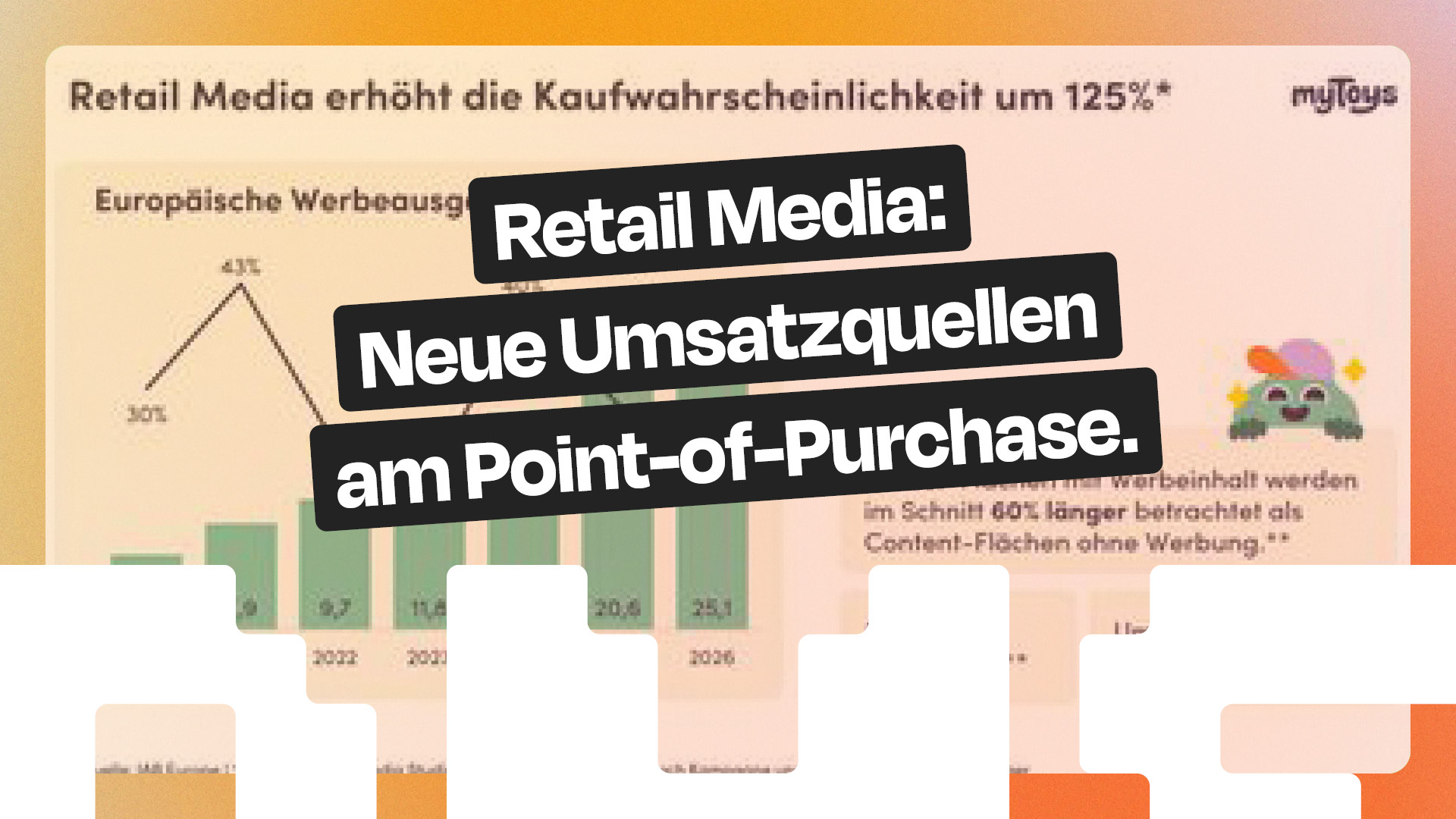
- European advertising spending in 2026 forecasted at €25.1 billion *
- European advertising spend YOY growth of 20% + *
- Teaser areas with advertising content are viewed 60% longer than non-advertised areas **
- ROAS up to 1,000% ***
- Turnover uplifts of 25–300% ***
These figures show just how much potential this area holds: Retail media makes it possible to act better — through perfectly coordinated content.
Please note: this DMS Talk is available in the German language only.
* IAB Europe
** Retail media study, heyconnect, 2019
*** varies depending on the campaign
Transcript of the DMS Talk – For Reading
DMS Talk – “Retail Media: How to Trade Better with Digital Signage”
Oliver Nitz (DMS):
Hello everyone, and thank you for taking the time to join our DMS Talk on Retail Media.
My name is Oliver Nitz, I’m CMO at Digitale Mediensysteme (DMS), and I’ll be your moderator today.
About us
We’ve been active in the market for 19 years, supporting retail companies, banks, and chain brands – especially those with physical locations – through services around Digital Signage, In-Store Radio (including programming and content design), creative content, as well as location analytics and frequency measurement.
Our approach: Digital with purpose – and ideally, connecting the digital with the physical. That’s what we enjoy most.
A quick note for everyone joining today:
You can take part via chat. Please enter your name first, confirm, and then type your question. We’ll collect comments, questions, and feedback throughout the session and address them together at the end.
All participants are muted; only my two guests have their microphones enabled – to avoid background noise. (And if a child walks into the background – we’ve all been there since the pandemic. It’s charming, but sometimes distracting.)
Why Retail Media Matters Now
We’re seeing that Amazon now earns significant margins from Retail Media ads – in fact, more than from e-commerce alone. Globally, Retail Media is estimated at over USD 50 billion and growing rapidly.
What’s exciting for retailers – both online and offline – is that 60–70 % of this revenue is incremental, i.e., new income (previously considered traditional trade marketing).
Why? Because you can advertise directly at the point of sale, provide information close to the customer, and in a sense, “advise” them.
To explain how this works in practice, we have two experts today:
- Bettina Arff, Head of Retail Media at the MYTOYS GROUP, and
- Luc Heijnen, Customer Experience Officer at EPIC Lifestyle Experiences, presenting a SPAR Netherlands case.
myToys represents the digital marketplace perspective, and Luc brings in the in-store setup. A highly interesting mix.
Input from Bettina Arff (MYTOYS GROUP)
Oliver:
Bettina, could you briefly introduce yourself? You’ve also brought a presentation, right?
Bettina Arff (MYTOYS GROUP):
Gladly – and thank you for having me, Oliver.
(A short trailer is shown.)
For those who don’t know us yet: myToys is the go-to retailer for young families.
Founded in 1999, part of the Otto Group since 2000. We’ve grown strongly over the years and – in addition to our online marketplace – operate 19 physical stores across Germany.
Our marketplace model makes us a multi-channel platform.
Key figures
We see several million visits per month and cover a very broad assortment – not just toys, but also children’s fashion, shoes, baby products, and nursery furniture. Altogether, we list around 3 million items, and together with our sister brand mirapodo, we reach about 7.5 million active customers – a strong base in the family target group.
We’ve been running Retail Media since 2017, very successfully.
Our key components include:
- Sponsored Product Ads – familiar highlighted product placements (similar to Amazon).
- MyBrand, a self-service platform (since 2020), enabling partners to run and manage campaigns independently.
- Live Shopping (since 2021) – shows like modern TV sales formats, but with direct digital interaction.
Our target group: roughly 80 % female, predominantly mothers. We typically accompany families from pregnancy through the children’s teenage years. The “average” user is in her mid- to late-30s, with one or two preschool-age children.
Why Retail Media? – Impact & Numbers
Studies show: Retail Media significantly increases purchase likelihood – e.g., teaser areas with advertising content achieve much longer dwell times than neutral content areas.
The category is growing rapidly in Europe – with ROAS values up to 1,000 % possible, depending on the campaign.
In our setups, we see uplifts of 25–50 %, and in favorable cases even higher. (Important: not guaranteed – always case-dependent, but results are consistently strong.)
The Right Measure at the Right Time – Along the Customer Journey
At myToys, we can cover the entire funnel:
- Awareness: Display ads, social, newsletters, prominent homepage or campaign placements.
- Consideration: Sponsored brand ads, content teasers, algorithmic recommendations on PLP/PDP (product list/detail pages) – e.g., when it’s clear “yes to puzzles,” but brand or model is still open.
- Conversion (POS Online): Sponsored Product Ads, etc., to drive purchase specifically.
MyBrand (Self-Service)
Our partners can create and manage sponsored product and display campaigns themselves – including budgeting, sales tracking, ROAS, and more.
This setup scales far better than manual management – especially with numerous marketplace participants.
Live Shopping (Shows & Clips)
Since 2021, we’ve been hosting live shopping shows (typically 30 minutes, professionally moderated, with a brand expert present).
The format allows product-close experiences – customers get “close” to the item, post live questions in the chat, and receive real-time answers.
Example KPI:
Shows consistently drive much higher basket sizes, order volumes, and revenues before and after the event (e.g., +235 % orders, +330 % revenue in the comparison week).
Discounts play a role but usually account for < 15 % redemptions – the main effect comes from the show itself.
New are our live-shopping clips (short videos, typically 1–2 products, 30–60 seconds).
These are placed directly on the product detail page (“rich content at the product”) – sustainable and conversion-driven.
Partners can either have clips produced by us or use a hub access model (flat rate) to produce and upload content themselves – making content production scalable.
360° Campaign Example (with LEGO – “90 Years of LEGO”)
A combination of online measures, live shopping, and in-store activations – 17,000 live viewers and excellent KPIs.
Such holistic setups work especially well for product launches and themed worlds.
Success Factors (from Our Perspective)
- Reach & data foundation – transactional and behavioral data within a clearly defined family audience.
- Relevant assortment & attractive advertising environment – visibility is everything.
- Full-funnel solution – from awareness to conversion, including live formats.
- Self-service for scalability & speed (MyBrand).
Together with suppliers and brands, this creates more sales and measurable value contributions.
Q&A (Excerpt) – Bettina Arff
Oliver:
On purchase probability – how do you measure that?
Bettina:
Through regular testing – e.g., A/B testing on PLP/PDP teasers, different placements and designs, then comparing click/view/conversion chains.
We don’t run full setups for every campaign (that would exceed capacity), but we test continuously and apply the learnings.
Oliver:
Are there categories where Retail Media works better?
Bettina:
It works across all categories – the “endless shelf” needs visibility. The differences lie in mechanics and budget logic:
For high-value single items, we plan differently than for broad assortments. Sponsored Product Ads are great for width; brand teasers/stories suit more explanatory products.
Oliver:
How well are the clips received?
Bettina:
Very well. Short, focused, directly on the PDP – exactly how our users consume content (think “second screen on the couch”).
And thanks to the hub model, partners can produce much more content – that’s key.
Oliver:
Tips for beginners?
Bettina:
It’s not a side business. You need focus, clear ownership, and the right tech.
Think early about self-service (otherwise it won’t scale) and about holistic measurement along the journey so KPIs remain comparable.
We clearly see: Retail Media works – and budgets increasingly come directly via media agencies.
Input from Luc Heijnen (EPIC Lifestyle Experiences) – SPAR Netherlands Case
Oliver:
Luc, your case focuses on the in-store setup, specifically SPAR Netherlands. Please introduce yourself and tell us what you implemented.
Luc Heijnen (EPIC Lifestyle Experiences):
Thank you for the invitation.
We’ve been active in the communications and CX space for over 25 years – from web & e-commerce to print, radio, TV, in-store communication, and mobile.
For SPAR Netherlands, we focused – complementing Bettina’s part – on media sales at the POS.
Purchase decisions are often made at the point of decision.
Physical environments engage multiple senses – visuals, sound, even scent.
Our approach at SPAR:
A programmable, monetizable retail media network in-store – using digital signage screens at key positions (entrance, checkout area, product categories) plus interaction via QR codes (discounts, product info, direct-to-cart).
Scale
SPAR operates 13,000+ stores worldwide, with very high daily footfall depending on region.
For media planning, what counts is how many real contacts you reach. The POS can be booked – and the frequency is measurable.
Data Protection
Compliance was essential. Some markets are testing camera-based attribution (gender/age estimation), but we use equally effective, less invasive methods.
For advertisers, there’s no real added value in personal data – agencies don’t pay extra for it, but compliance risks rise sharply.
So: No PII, clear consent flows, QR codes for interaction.
Results (Pilot → Rollout)
- Conversion uplifts: +300 % in pilot, stabilizing around +200 % in rollout (depending on category/creative).
- New revenue streams through retail media monetization – not only from endemic suppliers, but also non-endemic budgets (e.g., automotive, travel) that previously went to TV or online.
- Cost efficiencies: integrating hardware/software reduces investment, installation, and operating costs (scale effects).
Oliver:
Were there already screens, or was this new?
Luc:
It was new. The first goal was to enhance the in-store experience and atmosphere (moving images, relevant content).
The second: to give brands and suppliers a far more impactful in-store presence with animated content.
Oliver:
And how do media agencies see it?
Luc:
They’re increasingly allocating retail media budgets to in-store.
For retailers, that’s incremental revenue.
We see – similar to Bettina’s observations – strong sales and ROAS performance.
Oliver:
How did you approach implementation? Any recommendations for retailers?
Luc:
Three steps:
- Define concept & objectives – target groups, touchpoints, value drivers (brand, sales, traffic, revenue).
- Content strategy – pure “in-store TV” or interactive elements (QR, add-to-basket, coupons)? We used a combination – screens + QR.
- Monetization & operations – placement logic, pricing, booking, proof-of-play, reporting; privacy by design.
We call this the “Golden Brand Pipeline”:
The brand gains contact at the POS, interaction (QR), permission (opt-in), conversion (coupon/purchase), and re-engagement – clean, measurable, scalable.
Oliver:
Would you say the potential applies broadly in retail – or only in specific verticals?
Luc:
Broadly. When it comes to retail media revenue, multi-brand formats benefit most (more inventory for endemic and non-endemic advertisers).
Mono-brand retailers can also gain a lot (sales uplift, CX), though with different revenue structures.
What matters most is a solid business case.
Closing
Oliver:
Many thanks to Bettina Arff (MYTOYS GROUP) and Luc Heijnen (EPIC Lifestyle Experiences) – and to everyone who joined us.
We’ll publish the recording soon on our website digitale-medien.at and send the link to all registered participants.
Please feel free to share it internally.
Thank you – and have a great evening.
See you at the next DMS Talk!
More DMS Talks.