DMS Talks
AI — Retail in Focus.
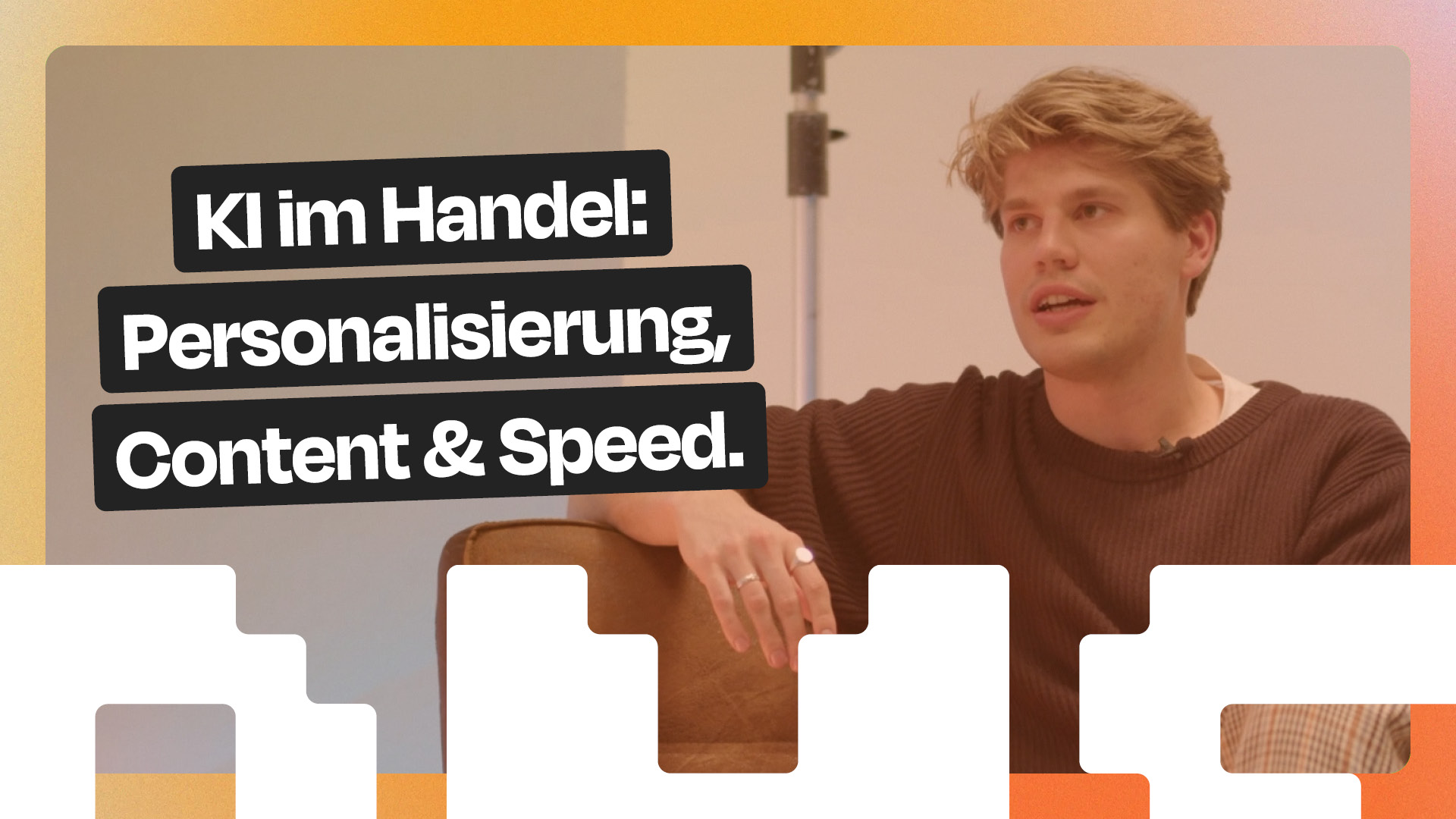
DMS Talk 9: Luis Knoke × Stoked AI × DMS — Talking AI and Retail the Modern Way
Another exciting DMS Talk — this time with Luis Knoke, an AI expert from Hamburg, in conversation with Oliver Nitz, CMO at DMS. Together, they explore the potential of AI in the retail space.
One thing’s clear from the start: the potential is huge — very huge. As Luis Knoke puts it, “AI gives you speed.”
Good News: Stoked AI — The Agency for Artificial Intelligence
Oliver Nitz and Luis Knoke have worked together for many years. At DMS, we focus primarily on Digital Signage, but also on solutions such as Instore Radio, Live Shopping, Live Recruiting and Frequency Measurement. Or, as we like to say: On digital with meaning.
With MUSE content, we’ve found the perfect partner. Luis Knoke, now a strategic consultant at Hamburg-based Stoked AI, began with live shopping and now focuses more on brand strategy — online and offline. When it comes to customer journeys and brand experience, he's the right fit for any challenge.
And here’s the exciting news: Stoked AI — a new agency entirely focused on artificial intelligence. For good reason. The topic is huge.
Not a Trend: The AI Revolution
For Luis, AI is far more than just a trend — he sees it as a full-blown revolution, on the scale of the Internet itself. That’s why MUSE Content is now leveraging Stoked AI. The potential? Massive. AI is changing everything — for the better.
Luis says:
"For me, AI is much stronger than a trend — we’re reaching a speed that has never been seen before. In all areas. AI touches everything, and we’re at a truly exciting point: where does it touch everything, in what form, and how can we use it?"
And when asked about trends, he puts it simply: “Trend? No topic has come up that is so much not a trend.”
Now It’s Getting More Personal: Reaching Customers Directly With AI
One major theme from this DMS Talk is hyper-personalization — a truly exciting field. With tools like ChatGPT, Storia, or DALL·E, newsletters can now be created in much more tailored and effective ways. And the results speak for themselves: AI-powered newsletters achieve higher click-through rates. Why? Because AI can serve each target group more precisely and personally.
The benefits of large language models (LLMs) go even further. Take chatbots, for example: since early this year, Klarna has been using a new AI chatbot that resolves two-thirds of all customer inquiries — and customer satisfaction hasn’t dropped. It’s just significantly faster. Luis also shares fascinating insights from the fashion world, including AI-powered styling tools that suggest the perfect outfit — making online shopping easier, more enjoyable, and more profitable. Efficient? Absolutely. That’s artificial intelligence.
If Content is King, AI Rules!
It’s not just about hyper-personalization — it’s also about speed. When it comes to content creation, AI opens up entirely new possibilities. Agencies can now shift their focus toward quality, saving valuable time on format-specific content production — from LinkedIn to Facebook, or adapting content for screens. Various AI tools act like digital toolkits, streamlining the process.
Luis also highlights new ways to generate video and audio content. Traditionally, brands have relied heavily on voice talent — but with AI, you can create voiceovers in virtually any tone or language, at lightning speed. It’s not just faster, it’s also more cost-efficient.
All That Remains Is the Question of Data Protection…
And Oliver and Luis don’t shy away from it. The conversation around artificial intelligence, especially when it comes to ethics and data privacy, is a fitting and forward-looking close to this cutting-edge DMS Talk.
One thing is certain: there will be plenty more to explore in future talks. We’ll stay tuned — and keep reporting.
But for now, it’s time to watch the latest DMS Talk now!
Please note: this DMS Talk is available in the German language only.
Transcript of the DMS Talk – For Reading
DMS Talk – Focus on AI (Artificial Intelligence)
Oliver Nitz (CMO, Digitale Mediensysteme – DMS):
Welcome to our DMS Talk focusing on Artificial Intelligence – and today, we actually have a live guest.
My name is Oliver Nitz, I’m CMO at DMS and your moderator.
We’ve been active in retail for 20 years, expanding physical spaces with digital solutions: digital signage, in-store radio including content (advertising formats and internal communications), and technical distribution. We also handle live shopping, live recruiting, frequency measurement, and similar services.
Our ambition: “Digital with purpose” – to meaningfully expand brand spaces, ideally with a wow effect.
Please welcome Luis Knoke from MUSE (Hamburg), a long-time partner. What’s particularly nice today: we’re sitting face to face in the same room – not just digitally. Luis is, among other things, Project Lead for Live Shopping – that’s how we know each other.
Luis Knoke (MUSE, Hamburg):
Thank you. I’ve been with MUSE for six years, working in different areas – initially a lot in live shopping, now more in the brand segment (brand strategy on- and offline, customer journey/experience). Since the beginning of this year, I’ve also been focusing more on strategic topics around AI.
STOCK is our AI unit – a dedicated agency with its own AI Studio. There, we develop AI integrations, innovations, and process optimizations for brands.
Oliver:
That’s why you bundled it in a separate unit – makes sense. You know your stuff, which is why you’re here today (and at the same time, you’re supporting our team in an internal training).
So – what does AI mean to you?
Luis:
Scientifically speaking, artificial intelligence imitates human thinking and behavior.
Practically speaking, AI is above all an enabler – it creates speed and scalability in areas that previously weren’t possible. That’s why it touches almost everything.
Oliver:
So, not just a passing fad?
Luis:
For me, AI is not a trend, but the next evolutionary stage – comparable to the Internet revolution.
The pace is extreme: new applications appear weekly, sometimes daily. This development can’t be “rolled back.”
Systems & Application Fields (Especially in Retail)
Oliver:
Beyond the well-known ones – like ChatGPT – what else do you see, especially with a view to retail?
Luis:
We can roughly distinguish between specialized models (for clearly defined tasks) and LLMs (Large Language Models) as all-rounders.
In the generative area, the relevant ones are: ChatGPT, DALL·E (images), Sora (video), and Midjourney (images). For video, also Runway.
In terms of applications, it spans from text (emails, newsletters, guidelines) to image/video/audio, as well as chatbots and hyper-personalization (e.g., CRM-based).
Examples from retail:
- Chatbots/Service: For example, Klarna – where the bot answers the majority of customer inquiries at least as well, but much faster.
- Consulting: Zalando or Hugo Boss are testing style advice via chat (including purchase and browsing history).
- Personalization: Newsletters and text modules are generated individually for each user – tone and relevance increase measurably, as do click and open rates.
Concrete Cases from Projects
Oliver:
Do you have concrete examples of what you’re working on?
Luis:
- Content Re-formatting at Scale
A classic challenge: a video needs to exist in many formats (Instagram post 1:1, story 9:16, Facebook, YouTube, website, in-store display/LED wall, etc.).
We use AI-assisted auto-focus reframing: define the focus once (e.g., athlete/product), then automatically render all target formats.
This saves massive amounts of time and rendering cycles – and we integrate it directly into existing pipelines. - Audio – Text-to-Speech / Speech-to-Text / Multilingual
Text becomes audio spots in multiple languages (including voice and tone selection). Today, it sounds natural.
Result: Iterations in minutes or hours instead of days (no need to book voice talent, studio time, or approvals). Extremely useful for in-store radio and social media.
Oliver:
Sounds like real quality – can you still tell it’s machine-generated?
Luis:
In many cases, no. Interestingly, AI-generated newsletters often perform better because they personalize more precisely.
The “batch size one” – fully individualized communication – is becoming realistic.
Internal Use & Data Protection (Container/RAG)
Oliver:
What about internal solutions – keyword: data protection?
Luis:
We avoid putting sensitive data into public tools. Instead, we use container approaches with API connections and combine LLMs with our own knowledge sources (RAG – Retrieval Augmented Generation).
That means: before the model responds, it only receives approved internal information (e.g., trends, campaigns, performance data).
This ensures responses remain consistent and compliant with data protection – and data ownership stays with the client (EU-based hosting or on-prem available on request).
Copyright & Terms of Service – What’s Allowed?
Oliver:
And legally? Copyright, data protection, terms of use?
Luis:
Key point: read the providers’ terms and conditions.
- Ownership: Pure AI output is often not copyright-protected (no “human author”). Once you creatively modify it, it becomes your own content – but usage can be restricted in the terms (commercial yes/no).
- Training base: Adobe Firefly, for instance, is trained on licensed stock material – therefore explicitly cleared for commercial use. With other tools, usage rights vary.
- Data protection: Clarify where data is processed (EU/on-prem possible) and whether logging/training is disabled.
We advise conservatively and remain tool-agnostic.
Offline/On-Prem Models & “Hallucination”
Oliver:
And what about offline models?
Luis:
They exist – local or on-prem. Advantage: better data protection.
Disadvantage: less “freshness” (no live web updates).
In general, you must expect hallucinations – therefore, it’s important to plan for guardrails, source validation, and human review.
Limits & “80–90% Solutions”
Oliver:
Where are the limits – and what’s the practical benefit?
Luis:
Many AI solutions today deliver 80–90% quality – enough to drastically reduce time and cost.
Example:
Previously, an audio update could take 1–2 days (voice talent, studio, editing).
Today, multilingual versions are ready in 1–2 hours.
Or post-production: instead of dozens of keyframes in After Effects, you simply mark an object – the AI removes it throughout the entire video (e.g. with Runway).
For social and always-on content, that’s more than sufficient.
Conclusion
Oliver:
To sum up, I see three main levers:
- Process optimization (reframing, rendering, automation),
- Quality & relevance (personalization, tone, multilingual output),
- New reach models (audio/podcast/video in multiple languages).
Luis:
Exactly. The important thing is to start now – the curve is steep.
Not “AI for AI’s sake,” but analyzing workflows, identifying time sinks, and automating precisely where it adds value.
More DMS Talks.