DMS Talks
Standort+Markt X Retail Association X DMS — a deep dive into retail spaces in Austria.
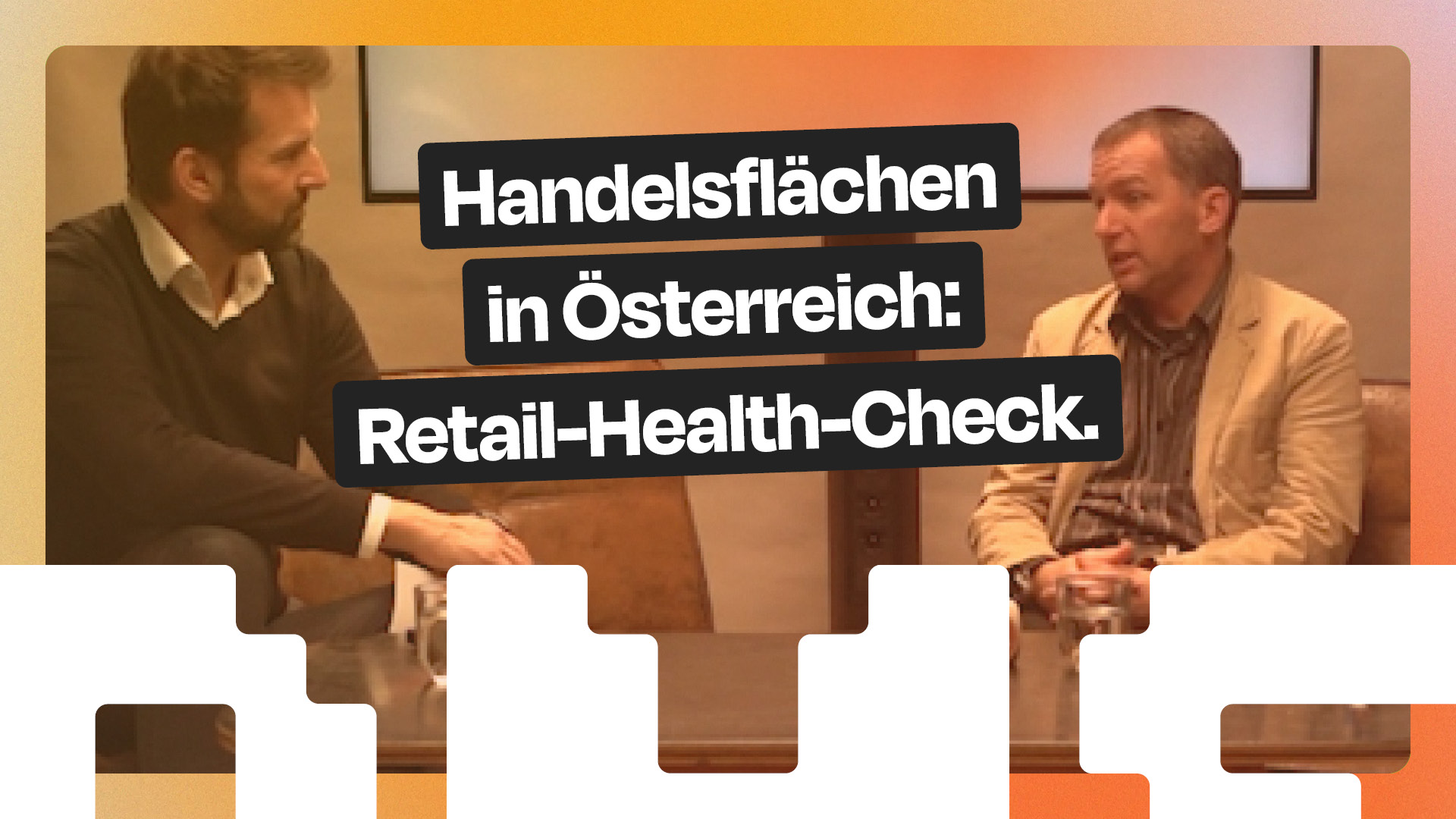
Changes in Retail Spaces in Austria — Insider Insights from Location + Market and the Retail Association: DMS Discusses the S+M Health Retail Check
This DMS Talk is a must-watch for anyone curious about the evolving retail landscape in Austria. Oliver Nitz, CMO of DMS, sat down with Dr. Roman Schwarzenecker from Standort + Markt and Manuel Friedl from Handelsverband to explore the latest developments. Together, they tackled critical questions about the future of retail in Austria: Which sectors are filling vacant spaces? Are flagship stores still relevant? And is empty retail space a warning sign — or an opportunity?
Location + Market and the Retail Landscape in Austria
We were pleased to welcome Dr. Roman Schwarzenecker for this DMS Talk — a conversation full of fresh ideas and insights. Since 2013, Standort + Markt has been delivering impactful research on Austria's retail landscape. Their long-running study, the "S+M City Retail Health Check" , now in its 11th edition, continues to offer valuable data — published in partnership with the Retail Association.
The S+M City Retail Health Check: Key Findings
The 2023/2024 edition offers new insights that help Austrian retailers make more informed business decisions. It covers 24 retail zones — including shopping streets and 16 selected small towns — analyzing over 13,300 shops across nearly 2 million square meters of retail space.
A Loss of 9,000 Square Meters: Urban Fashion Retail Takes a Hit
One striking finding: Urban retail areas have shrunk by 9,000 square meters. Since 2018, Standort + Markt has tracked a steady decline in retail space demand. The reasons? First came the pandemic, followed by inflation and a real estate crisis — all of which shifted consumer behavior. The fashion sector has been hit particularly hard, losing ground to online shopping since 2014.
“It’s encouraging that vacancy rates in 40 inner-city areas across Austria have dropped slightly — from 6.8% to 6.7%. But that’s largely because many of those spaces are being repurposed,” explains Rainer Will from the Retail Association. “Medical practices and hair salons, for example, are replacing traditional retail.” His colleague Manuel Friedl offers even more insights in DMS Talk 8.
Please note: this DMS Talk is available in the German language only.
Transcript of the DMS Talk – For Reading
DMS Talk – City Retail Health Check 2024
Oliver Nitz (CMO, Digitale Mediensysteme):
Welcome to our DMS Talk – I believe it’s already the eighth edition.
Today’s topic: The transformation of retail spaces in Austria – the “City Retail Health Check 2024.”
My name is Oliver Nitz, and I’m delighted to host today’s discussion.
At DMS – Digitale Mediensysteme – we’ve been working in the retail sector for 20 years, expanding physical spaces with digital solutions: digital signage, in-store radio including content, frequency measurement, and location analytics. We monitor individual store locations as well as overall market trends.
Today, we’ll look at facts and figures that shed light on exactly that – something I’m very much looking forward to.
Our motto: “Digital with purpose.”
Please join me in welcoming Dr. Roman Schwarzenecker (Standort + Markt) and Manuel Friedl (Austrian Retail Association).
Introductions
Dr. Roman Schwarzenecker (Standort + Markt):
I am managing partner of Standort + Markt. The name says it all – we prepare location and market analyses, especially for the retail sector, and have been publishing regular reports since 1988 – with a scientific approach, since there are few consistent, reliable long-term studies in retail real estate.
I’ve been with the company since 1996 and also serve as Secretary General of a trade association for retail real estate.
Manuel Friedl (Austrian Retail Association):
I work on the communications team at the Austrian Retail Association – the independent, cross-sector, and voluntary advocacy group for Austria’s retail industry.
Our members include many major players from grocery, fashion, and electronics – as well as around 4,500 SMEs (and more are welcome; SMEs can join for free).
In the City Retail Health Check, we support public relations and presentation. Data collection and methodology are handled entirely by Standort + Markt. From the results, we derive recommendations for action.
Origin & Methodology of the City Retail Health Check
Oliver:
I first came across the Retail Health Check in 2017 through the Retail Association (back then, among other topics, it covered Vienna’s Mariahilfer Straße) – very interesting. What exactly is the Health Check, how does your analysis work, and how do you select locations?
Roman:
We began collecting data in 2013; this year marks the 10th/11th edition (the City Retail Health Check exists since 2014).
Historically, we started with shopping centers – including defining what qualifies as a shopping center versus a retail park, originally based on ICSC standards and later adapted for Austria (with local floor-space thresholds).
By 2000, we also included retail agglomerations and retail parks (for example: the SCS in Vösendorf and neighboring large-format retailers).
For city centers, however, there had long been no reliable data – plenty of opinions, but little measurable evidence. So we began comprehensive mapping:
- Recording every shop in the city,
- Capturing address, type of use, and especially sales area (since tools like Street View don’t reveal store depth or multiple floors).
Today, the database includes around 13,300 shops.
Scope of study:
- 20 cities (the largest ones plus Eisenstadt; Vienna divided into five business areas, e.g., Innere Stadt, Mariahilfer Straße, Favoritenstraße, Landstraße),
- Plus 16 small towns.
We cluster these 40 cities into primary, secondary, and small cities. Data is collected annually, in close cooperation with local city marketing teams.
Condition of City Centers – “Health Status”
Oliver:
So how “healthy” are Austria’s city centers?
Roman:
Better than often claimed – but clearly undergoing change.
The hard vacancy rate (based on floor area) has remained stable and even fell by 0.2 percentage points this year.
Nevertheless, many perceive the situation as worse. The reason: the total retail floor area in city centers has been declining since 2018 (after previously increasing).
Over the past ten years, the reduction amounts to about 3.2 %.
Retail spaces are being repurposed – into offices, medical or health centers, law firms, or apartments, sometimes for public use.
We distinguish between:
- Hard vacancy (no new use identified), and
- Vacancy under redevelopment (reuse already foreseeable).
The share of “under redevelopment” is rising – partly because our data quality improves each year through repeated surveys and cooperation with local city marketing teams.
Shifts in Use & Retail Segments
Oliver:
How is the face of shopping streets changing?
Roman:
Fashion has lost about 5 percentage points of market share over ten years – roughly 100,000 m² across the 24 primary and secondary cities (about the floor space of a Donau Zentrum devoted solely to fashion).
Gastronomy gained about +1.5 pp – but “Gastro = new Retail” is too simple; the decline in fashion wasn’t compensated.
Vacancy (including redevelopment) has roughly doubled (from ~4 % to ~8 %).
Drivers: shift of consumption online – especially in fashion.
Under pressure / stable / gaining:
- Under pressure: Fashion; Home & Living partly affected by large retailers’ retreat.
- Relatively stable: Electronics.
- Gaining: Gastronomy, services, fitness, betting shops; discount and variety chains (ACTION, TEDi, PEPCO); grocery and drugstores (slight growth, partly through expansions or using previously “difficult” locations).
Online share: Still very low in grocery (~1 %) and modest in drugstores – many discounters deliberately avoid online shops to maintain in-store traffic.
Closures, Insolvencies & Fluctuation
Oliver:
A study quantified major store closures between 2020–23 at around 93 per year (including insolvencies). How does that fit into your data?
Roman:
We measure the fluctuation rate (usage changes per year). It has remained around 12 % for years – temporarily lower during COVID, but now back to normal.
That means: on average, every shop changes its use about once every eight years.
A-locations are more stable than B-locations; larger cities are more stable than smaller ones.
Manuel:
We’ve seen more insolvencies over the past one to two years – due to the expiry of COVID relief measures, deferred payments, and rising costs.
There are also cyclical patterns: expansion phases versus contraction phases.
Example: PEPCO – rapid expansion to 70+ stores, then an equally rapid pullback.
Austria is a highly competitive market with high costs (rent, staff), strong service expectations, and dense competition. Those who underestimate that, struggle.
On the other hand, there are success stories like Woolworth: no online sales, focus on in-store traffic, market entry in Austria, first branches (e.g. Lugner City), with a goal of ~130 locations – showing that opportunities still exist.
Auto Retail in the City
Oliver:
Car showrooms moving into cities – we’re seeing pop-ups and brand stores in Vienna. Is that a trend?
Roman:
Mostly a Vienna phenomenon – or seen in very high-footfall locations.
Background: Car-buying behavior is changing (configuration online, test drive and experience on-site).
Hence compact urban stores make sense. In shopping centers, pop-ups are becoming more common.
What Can Cities Do?
Roman:
Much of it is structural: the average retail unit is around 154 m², while many new concepts require 600–1,200 m².
Merging spaces is often legally or structurally difficult (fire safety, heritage protection, accessibility).
Simplified procedures and active real estate development can help.
Crucial is linking online and offline: combining retail and gastronomy, pickup services, and service touchpoints – creating reasons for people to come.
Manuel:
Retail goes where good business is possible: quality of stay, safety, cleanliness, and local programming.
If those are right, people will accept longer walks or the lack of parking at the door.
When vacancies and declining quality take over, recovery takes patience – and engaged local policy and city marketing.
Often, the most effective lever is having people who care – even with small budgets.
Examples:
Mödling performs exceptionally with only ~6 % vacancy – despite having the SCS shopping center nearby.
Shopping centers don’t have to “kill” city centers – they can be complementary.
What matters is active city management (e.g., Wels, Wiener Neustadt).
Using the Data / Services
Oliver:
Based on your data – if I want to expand, can I commission you?
Roman:
Yes. We advise on location decisions, and thanks to our annual full survey, we have an excellent data foundation.
Expansion managers usually know “their” cities very well – but comparing them nationwide using consistent methodology is an additional value.
Oliver:
Where can the study be accessed?
Roman:
At standort-markt.at → Products → City Retail Health Check.
More DMS Talks.