DMS Talks
MOONCITY Vienna — A Wow Experience With Porsche Media & Creative in the Pop-Up Store.
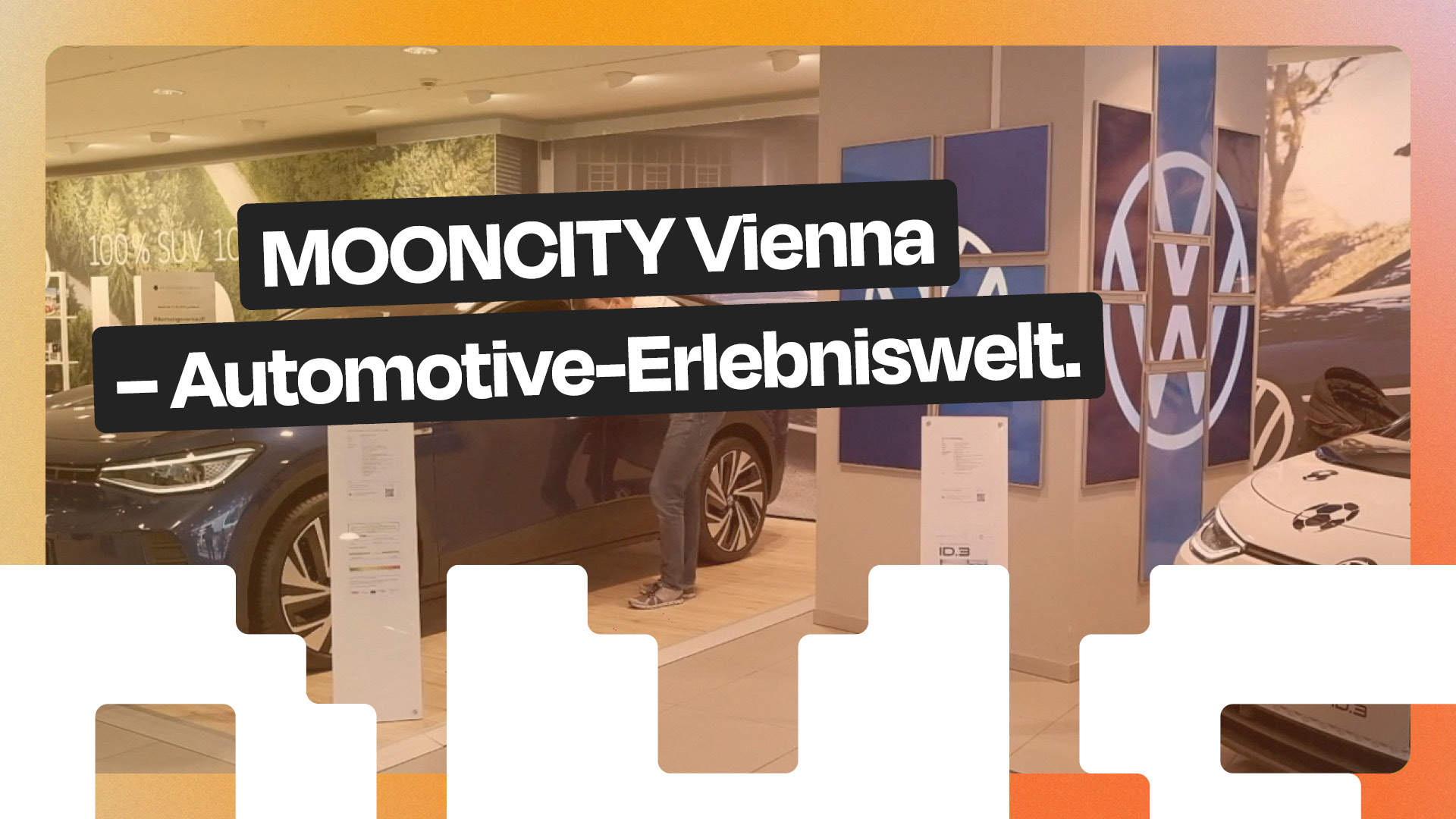
Pop-Up Stores Offer Powerful Opportunities in Retail: Vacant retail spaces in prime inner-city locations can be used to great advantage. Temporary pop-up stores hold long-term potential — and Porsche has proven it by turning MOONCITY Vienna into a premium showcase. Since opening in autumn 2021, this centrally located concept store has attracted countless visitors — and inspired them. Situated right on Vienna’s bustling Mariahilfer Straße, MOONCITY Vienna makes e-mobility tangible, accessible, and truly engaging.
Together with Porsche Media & Creative, DMS created an immersive experience through games, interactive screens, and more to deliver a true wow moment for all of Porsche Holding’s flagship brands.That’s exactly what Andreas Martin from Porsche Media & Creative, Bernhard Loos from Audi Austria, and our CMO Oliver Nitz explore in this DMS Talk: the new opportunities in retail that are now starting to “pop up.”
Please note: this DMS Talk is available in the German language only.
DMS Talk transcript for reading.
Welcome & Good Evening
Hello and good evening to our third DMS Talk – today on the topic of digitalization of pop‑up stores. My name is Oliver Nitz. I’m on the team at Digitale Medien Systeme, based here in Vienna, and I’ll guide you through the evening.
Notes for Participants (Chat & Questions)
Before I get to our two guests, a few notes for you as participants: You can ask questions. We will collect them until the end of the DMS Talk and then be happy to answer them together. To do this, please click on the speech bubbles at the top right of your screen, and enter your name underneath – not the question; please enter the name first, the question underneath, and then submit it. As I said: we will answer them accordingly at the end.
Gests of the Evening
Please join me in briefly welcoming Andreas Martin and Bernhard Loos – we’ll take a closer look at both of them in just a moment.
Why Pop‑up Stores?
What is today about? The topic of pop‑up stores didn’t just become an issue due to the most recent developments in city‑center locations; essentially, pop‑up stores are an extremely good opportunity for brands to enter city centers at short notice in prime locations and to make very smart use of vacant retail spaces. This applies not only to the brands themselves, but also to operators, who make use of their vacancies to appropriately position good brands – for example here in Vienna’s Goldenes Quartier.
That means: there were short‑term vacancies, a well‑known international brand was brought in, which was able to rent there as a pop‑up store for three months – in order to avoid vacancy with a high‑quality offering and to be able to rent out better and more long‑term.
Purely digital brands use pop‑up stores today for themselves to try out a market entry – as a branding opportunity. By name, there are a few – for example eyewear manufacturers from Germany – who do this extremely successfully: entering cities with a color concept. And for shopping centers this essentially also means a chance to revitalize different areas today. Everyone knows this: sometimes there’s one or another “dead corner,” and pop‑up stores are then also gladly used there.
Guest 1: Andreas Martin (Porsche Media & Creative) – MOONCITY Vienna
Let’s turn to my first guest today, the dear Andreas Martin from Porsche Media & Creative. Hi Andi – and please tell us a few things about yourself and what you actually had in mind here with MOONCITY.
Andreas Martin: Yes, hello dear Oli – we’ve known each other for a very long time, and recently also in this constellation – that is, as the operator of the so‑called MOONCITY here in Vienna. Perhaps very briefly by way of background: Porsche Media & Creative is the original in‑house agency of Porsche Holding in Salzburg, and in this context – for our group brands in the company – we are, among other things, responsible for the topic of events. And MOONCITY is indeed to be seen as a marketing and sales action; therefore we were, so to speak, empowered by our clients, Porsche Austria or the individual brands, to bring this concept to life.
And yes, you already mentioned some things in the intro – keyword vacancy and opportunities that should be used. That’s how it was here at this location on Mariahilfer Straße last year in the summer, among other things, that through a third party, through a business partner, we were made aware of this vacant retail space. And yes – we naturally dealt intensively with innovative and new marketing approaches, and – due to our know‑how – the idea then was, as an automaker, to really move into the inner city once and try out a MOONCITY here in the federal capital Vienna as part of a pop‑up concept. With the background that in Salzburg we have a permanent installation of a MOONCITY – which is a little different in concept, but the basic idea is of course the same, namely a marketing and sales activity for our group brands.
Moderator: Okay – and in a good, high‑traffic city‑center location. I understand. Can you say anything about visitor numbers or the like? Perhaps give us a sense – happy with ranges, if you’re not allowed to say too much – whether it’s going well or not.
Andreas Martin: It’s going well – apart now from the lockdowns. Naturally it’s a bit difficult – I think that always depends on the individual situation. Covid has, in many ways, on the one hand thrown a wrench in our plans; on the other hand, we ourselves were surprised – by the high demand or the strong need – simply this desire for electromobility and everything around it.
We launched this concept here on September 17, 2020. It was originally planned for three and a half months – and despite the two lockdowns up to the end of the year, we were already able to welcome a great many visitors. As of today, there were around 50,000 visitors. From the baseline frequency that we – thanks to DMS – also measure daily, there were 50,000 visitors here in our showroom – that’s quite a lot. Also – and I was told – 144 actual sales vehicles: that is indeed a nice number.
Especially since one has to say that the people – that’s also a bit of an experience – who come here are all, or for the most part, very well informed. So people don’t just drop in “from shopping across the way” on the spur of the moment, but really have a concrete need for information and ask very precise questions.
Moderator: Could one say that this leads to more people engaging with the brand and submitting more inquiries at the end of the day than they actually would – because the trip to, let’s say, an outlying district of Vienna to a car dealership would be too far, or because it’s just convenient right now?
Andreas Martin: Yes – so I do think that the customer journey in this area is changing a bit as well – keyword digitalization. People naturally inform themselves very thoroughly via our digital channels – there’s a lot there; when it comes to the vehicles you can really obtain very precise, relevant information. Electromobility, however, is now not just the vehicle as such – it also has a great deal to do with the charging infrastructure. That is also the brand MOON that we brought to life, which provides precisely these solutions – keyword wallboxes, intelligent charging cables up to complete systems with photovoltaics. And then there are still many open questions for a potential customer. To give that last ounce of information, this is a top location. You don’t have to – as you say – drive out to the periphery, but have it in the inner city. And we have the impression that this concept is exceptionally well received by consumers.
Moderator: I didn’t know the MOON brand before – and for me personally it was interesting to get to know the topic of charging and electromobility. Not necessarily out of a desire for a car, but: how does the whole thing work? – and that’s actually neatly solved – respect. So one can speak of a success: lots of visitors despite lockdowns, or rather around them.
Frequency Measurement in MOONCITY (Interview with Christian Felix)
Moderator: Andreas was kind enough to mention the topic of frequency measurement that you use here – we’ll get to that a bit more in a moment. In an interview, we have one of the store managers, Christian, on the subject of frequency measurement here in the house – i.e., as part of the digitalization of pop‑up stores. I asked him two or three questions, and he explained what he uses it for operationally in running MOONCITY Vienna and how he deploys it. Here’s a short clip.
Moderator (clip): With me here is Christian Felix, the manager of MOONCITY Vienna, and we’ll briefly talk about the topic of frequency measurement, which is in use here at MOONCITY Vienna. Christian – hello.
Christian Felix: Olli, hi – hello.
Moderator: What do you use frequency measurement for?
Christian Felix: We use frequency measurement to capture classic entries and visitor flows. That is: we naturally want to know how many visitors are with us every day. We also measure dwell time – very important: How long do visitors stay with us? The length also has to do with the consulting effort. We have a very consultation‑intensive task here – which means we also measure consultation per visitor (i.e., consulting time). Of course, we also measure revenue per visitor. And, since Corona, we also have to measure: we have a certain limit here in the store; the limit must not be exceeded – and that works just great.
Moderator: Do you measure promotions?
Christian Felix: Yes – indirectly, of course. Over the months that we’ve had the tool in use, we of course know exactly how many people are with us on which weekday, at what time of day, on average. It’s weather‑dependent, of course – but yes, we do see it: with promotion outside there is, ideally, a small increase on that day. You can then calculate the success retroactively.
Moderator: Where do you see the numbers?
Christian Felix: We have a really wonderful dashboard. I can see exactly how many visitors are currently present – and the total for the day. It’s really very easy to read.
Moderator: Okay – great. So that’s “in my pocket” and available all day.
Christian Felix: Exactly – right.
Moderator: Super – good. Thank you.
Why Frequency Data Matters for Marketing & Sales
Moderator (back in the studio): Christian was kind enough to answer a few questions in the interview. What was interesting for me – also from working with him – was: you introduced it, and it was exciting to observe how intensively he used it. For him, it was often the observation towards Corona requirements, above all that you’ve stored the square‑meter count accordingly here – which is of course a great thing.
Question to the marketer: What do you do with the frequency measurement – and where is it a real added value for you? Why did you decide in favor of it?
Andreas Martin: From an agency point of view – as a contractor – you are of course accountable to your clients for the not insignificant marketing investment. There, key figures are a good measurement index – and it was clear from the outset that we had to give our customers full transparency and needed something so that the colleagues in Salzburg are informed daily about the status. First and foremost that was the frequency measurement shown, which concerns the baseline frequency here in the location. Beyond that, of course, there are many other KPIs that we document and measure – ultimately it’s about sales or the actual lead that we, at the end of the day – because, as I said, it’s a marketing action – can feed back to our dealer network.
Moderator: Can you establish a relationship to marketing measures outside? I’ll say: when there is a TV report running or in a magazine, or you carry out promotion activities on the street – is there a connection to be seen in the numbers?
Andreas Martin: Automotive is naturally difficult, because the customer journey is very long and we focus strongly on image advertising. An individual action is often hard to assess. Nevertheless, we – particularly with regard to the marketing aspect – have our tools & systems in the background. In sum, it’s about the interaction of all channels – and this is a new, innovative channel that certainly makes a not inconsiderable contribution.
Moderator: For me what’s exciting is: with frequency measurement I’m beginning to measure spatial experiences in the end much like a website. I can see how many come in, how many are out on the street, how many go up to the first floor – e.g., to the merchandising area. For those unfamiliar: feel free to drop by – or in other stores look at the ceiling in the entrance area – above the door there are usually sensors. No, no videos are recorded there – but it’s exciting to see how small something like that is today. And for those interested: how far‑reaching the measurement can be …
Guest 2: Bernhard Loos (Audi Austria) – Gamification at the POS
Moderator: Thank you to start with – continuing on the topic of digitalization in the store. Let’s turn to the dear Bernhard Loos. Audi has used screens at the POS here in the house in order, by means of a game, to create engagement – if you will – i.e., an on‑site interaction with the brand for consumers. Via a game that can be operated via the smartphone. That is: the smartphone becomes the controller. I’m happy to show you briefly how it works: I took my phone, essentially scanned a QR code, and connected via it. It’s called “de‑ice Audi” – that is, I can then de‑ice the Audi on the screen via my smartphone and, if I did it right, I get a cap at the end – in this case for sun protection. It worked great – I think it’s very good, above all because it’s so simple.
And I believe that in the course of vaccinations and testing the topic of QR codes is now established – consumers have understood what you can use them for: for registration – and also to establish a connection to a game on the screen. Dear Bernhard, feel free to say a few things about yourself – I’m glad you’re here – and I’d like to understand why you are doing this. But first: what do you do?
Bernhard Loos: Thank you, Oliver, for the invitation. Bernhard Loos – as I said, marketing and sales director for Audi in Austria. I work at the importer of the Audi brand in Austria in this function – again for quite some time. In 2017 I took over the head of marketing role, last year I also took on the sales agenda. Accordingly – just as Andreas Martin already said – for us this is naturally a marketing measure that we are implementing here, but also a sales measure. In this – as already mentioned – long customer journey we of course want to generate prospects, convert leads – and MOONCITY …
Before I get to the topic of digitalization – in addition to what you said – MOONCITY is, for me, neutral ground. The customer can receive comprehensive advice without pressure – not in the “fixed brand showroom.” A good entry point – and that brings me back – is definitely gamification. That lowers the inhibition threshold. Gamification is not new for Audi: in 2017 we launched a Q7 campaign nationally – on the one hand a game for the phone, on the other hand on site – e.g., in a motion seat – you could experience driving. Impressive. Important: incentives, brand fit – and a good entry point to the topic. Placed downstairs at the entrance – as you tried out – it picks up people as they enter the space.
Moderator: A quick follow‑up question: Do Audi dealers also use this place – is it used as a space – or is it rather seen as competition?
Bernhard Loos: It’s a complement, not competition – that applies to other brands as well. It’s a very good platform, neutral – we have the option of showing cars of which there may not be so many in one place. If new models, of which there are initially only a handful of vehicles, were distributed among 70 dealers – that would be suboptimal. In MOONCITY we can show them concentrated. And we still need the stationary retail – here the expertise on the topic of electromobility is definitely represented. MOON stands for Movement – and electromobility is a movement. For trade‑in, maintenance, offer – that requires more intensive consultation; one doesn’t purchase a car that often – a luxury good.
Live Consultation During the Lockdowns
Moderator: During the lockdowns – I saw on your website that there is live consultation – i.e., digital. Two or three sentences on that: How does it work? How is it received? Is it worth it?
Bernhard Loos: Yes – of course; otherwise we would pull the plug. Origin: We started the online consultation years ago – when retail is closed, online interaction often increases; you can see that in web traffic – and that doesn’t just happen during classic working hours. Online consultation was the first step: offer a touchpoint, answer questions, route leads – otherwise the effect would be limited.
A logical step in the Corona/lockdown period: if the customer can’t come to retail, we provide a touchpoint with live consultation – implemented together with our colleagues in Germany. At an Audi location there are several vehicles; you book an appointment with a product specialist – neutral – who explains things in general. If the customer wishes, a lead arises from it – and that lead is much hotter than if you immediately push an offer.
Moderator: I find it exciting that a dedicated room is set up for it – a virtual showroom, so to speak – where vehicles are staged.
Digitalization at the POS: Screens & Content
Moderator: What are your thoughts for the future – digitalization in the store environment?
Bernhard Loos: Many points have been mentioned: city‑center locations, vacancies, pop‑up space. We have a broad product portfolio – that needs space. The opportunity of digitalization: to bundle derivatives and, with VR or other tools, offer a full brand experience in a small space. That’s the big opportunity.
Moderator: And when is it a success – outside the showroom, for example here? I heard that dealers are sometimes brought along.
Bernhard Loos: As head of marketing: when the media KPIs go up – clearly; we’ve put in a solid increase there. As a salesperson: I want leads not only “in the cloud,” but ultimately as orders in the system.
Opportunities also show up there: assistance systems are hard to show in a static showroom – unless you smash the window (laughs). Digitally I can explain them very well – standardized and cleanly integrated into the process. That way, consultation takes place that otherwise perhaps wouldn’t – because a salesperson doesn’t yet know the system in such detail, or similar. Result: increase sales – and convince the customer of the vehicle.
Moderator: Shift of touchpoints: Is there a tendency to see less use of the showrooms?
Bernhard Loos: The physical visits become more valuable. In the past the customer came 2–3 times – today a lot happens online. You have to provide touchpoints beforehand – and the customer wants that to continue: if I configured online, I want to continue seamlessly in the showroom, not start all over again.
Tech Insight: Screen System (Interview with Michael Buchacher, DMS)
Moderator: Thank you for the details on the POS. At the entrance you saw screens – alongside gamification. That’s an entire system. I interviewed Michael Buchacher, CEO of Digitale Medien Systeme, about it – he gives us a brief overview of the solution.
Moderator (clip): With me here is Michael Buchacher, CEO of Digitale Medien Systeme. DMS equips MOONCITY with, among other things, a screen system. Michael – what can it do?
Michael Buchacher: First: the devices are extremely flat and light – essentially digital picture frames from the art space – with identical frame optics across many sizes and special formats. Second: everything is built into the device that you need to operate one or more screens – concerted or individual. Elegant, light, functional.
In terms of content: This is not a standard solution like a “generic video wall.” Due to the optics, technology and weight there are few sources worldwide. We’re a partner and build solutions for design demands – e.g., here in MOONCITY. You can build video walls or cohesive visual solutions that you otherwise don’t see like this.
Moderator: “Light” means: can I mount them anywhere?
Michael Buchacher: Yes – without major shopfitting. MOONCITY uses a lot of event technology – flexible. You can hang screens on the wall or on furniture – often two screws are enough. Installing a single screen takes 15–20 minutes – including software setup and going live.
Moderator: How does content get onto them?
Michael Buchacher: Via app – also multiple screens as a triptych: a photo of the arrangement – the software masks the gaps automatically, lays videos across all screens. Rotation is detected, content adapts. Simple.
Moderator: Bottom line: it’s not just a screen that plays content – but a construction kit for configurations, light, quick to install, aesthetic. Thank you!
Practice & Content Control
Moderator: Extremely exciting product – also interesting for art (the frame look). I had one brought in – basically as thin as a picture frame. Player/computer integrated, thin cable, mounting included – super light. You know it from events. For me it’s a top solution – including games, walls, auto‑rotation. You can do very beautiful things with it – also in the event space. Perhaps that was one of the reasons you opted for it?
Andreas Martin: Yes – much of it has been mentioned anyway, also with Bernhard’s Q4 launch example: the set here – first‑come principle – content is king. The store stands and falls with the top products of our brands. As operator/agency we have to be extremely flexible – lead times, communication – sometimes it goes faster, sometimes it takes longer. Digitally playable solutions are an enormous asset there. And from a marketing perspective – or for the end consumer – it’s a content marketing action: moving image tells stories – flexibly – a clear advantage over classic stand construction. I can hardly wish for enough screens.
Moderator: Where do the contents come from?
Andreas Martin: A lot comes pre‑produced from our brands. We, as an agency, prepare special applications. Advantage: control – a uniform brand appearance across digital retail modules; dealers select from a basket what is regionally relevant, topics are current. Example: if there’s a Q4 hanging downstairs, you play matching content – red thread, recognition for the customer.
Q&A (Frequency Measurement, Game, Control)
Question: “How great is the effort to set up frequency measurement? Major structural changes?”
Moderator: Relatively low: the sensor is very small, is installed in the entrance area and connected to the internet – behind it is proven software (used at airports, among other places). Switch on – done.
Question: “Do you also make the ‘scraping ice’ game for other customers?”
Moderator: Yes, in principle brandable – it has to fit the brand.
Question: “Can visitors control content/vehicles on the monitors via their phone?”
Moderator: In the sense of gamification – yes, possible. In the past there was also a standalone app (iOS/Android).
Closing & Farewell
Those were all the questions – apparently well clarified (also a good sign for our team behind the camera). I hope everyone enjoyed it – we’re well under time today (extra because of the Football European Championship), so you can prepare in peace and the beer is hopefully cold.
Many thanks for your attention! Feel free to send questions afterwards as well. We will put the third DMS Talk on the topic of digitalization of pop‑up stores online and send the link to all participants – feel free to share it. Thank you – and have a nice evening at the Football European Championship!
Bernhard: Thank you – and thanks for the invitation.
Andreas: Many thanks – and for the professional service.
Moderator: We have to thank you.
More DMS Talks.