AI-generated music in retail: The future of in-store audio & retail media
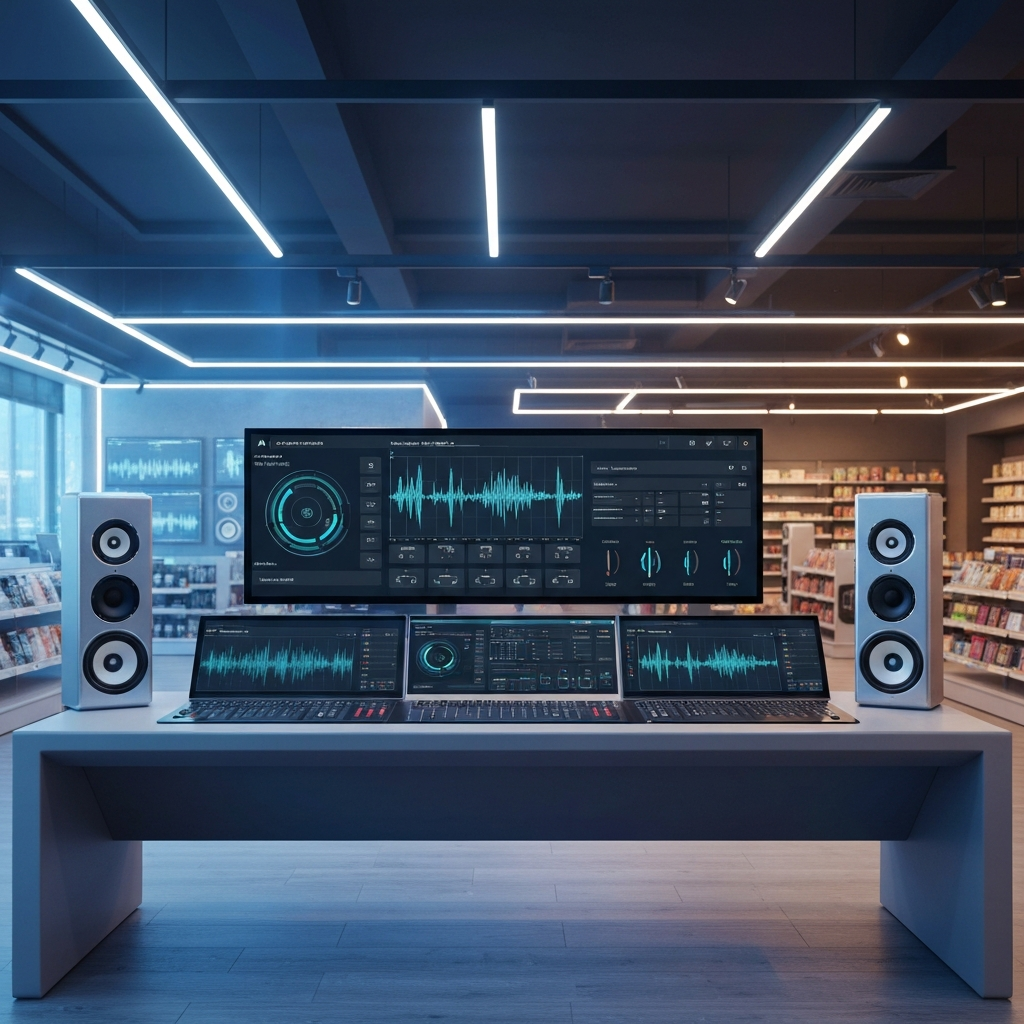
Why in-store audio in retail is reinventing itself right now
For decades, background music in retail followed the same principle: a rigid concept, defined once, rarely changed. Anyone walking through supermarkets in Russia or Istanbul today already experiences a different reality — almost all audio content, from advertising spots to background music, is fully generated by AI. What is already everyday practice there is now reaching the German-speaking market as well — and faster than many decision-makers expected.
Key Takeaways
• AI can automatically generate music and audio spots for stores
• Retailers save licensing costs such as AKM (Austria) or GEMA (Germany)
• Adaptive music reacts to visitor frequency and time of day
• In-store audio becomes a programmatic retail media channel
• AI music could become the industry standard within three years
From briefing to finished spot: How AI produces audio spots
The process of audio spot production has fundamentally changed. Customers today receive their own interface through which they go through a complete briefing: enter text or have it generated, choose a voice, define the sound bed, adjust the mood and set the volume. Only when the briefing is fully completed is the spot commissioned. This significantly reduces follow-up questions and accelerates the entire production process.
The DMS system runs in up to ten languages. For German-language content, a largely automated workflow is now possible, with human control. In international productions — for example Polish spots — a human approval layer currently remains: someone listens to the finished spot before it is played out. This intermediate control is not a step backwards but a deliberate quality assurance measure. A voice-cloning feature has also recently been added: companies can upload synthetically generated employee voices and use them permanently in the system — provided that consent and opt-out regulations are legally clarified in advance.
AI-generated music replaces classic licensing models
Parallel to spot production, a dedicated music library is being created, currently containing between 5,000 and 10,000 AI-generated tracks. Briefings define the desired music style; the system generates suitable songs — including vocal tracks. Before a track is added to the library, an employee from the music department listens to the first 20 to 30 seconds and decides whether the song meets the quality requirements. This principle of human intermediate control prevents nearly identical tracks from dominating the rotation.
The decisive advantage compared to licensed music is obvious: AKM (Austro Mechana) or GEMA fees and comparable charges are eliminated. Well-known fashion houses in Germany have already switched their stores — hundreds of locations — to AI-generated music for more than a year. Customer acceptance exceeded all expectations.


Adaptive in-store audio: Music that adapts to the store
The next development step is called Adaptive In-Store Audio. The soundscape of a store changes in real time depending on data points such as time of day, visitor frequency or the demographic composition of customers. In the morning, calmer music plays; when many young people are in the store, the playlist automatically shifts toward more dynamic sounds.
The system connects to existing data interfaces in the store. Technically, the step from static to adaptive playback is manageable — conceptually, however, it marks a turning point. For 50 to 60 years, in-store audio followed a rigid concept. For the first time, the soundscape changes like a living organism that reacts to its environment. Two customers are already testing the system in live operation.
Audio becomes the new retail media channel
Anyone monetizing advertising space in retail has so far mainly thought about displays and screens. Audio largely remained outside the picture — apart from radio stations and podcast environments. That is currently changing. Initial providers are allocating budgets to market audio spots in physical retail programmatically. Audio files can thus be planned and activated just like video content in the digital out-of-home sector.
Pilot projects are currently running with several supermarket chains. One explicitly required an AI-driven system with a programmatic interface in its tender — a clear signal that the market is setting the direction. Blacklist functions ensure that competitor advertising can be specifically excluded. This creates, for the first time, the possibility to market audio advertising space in retail freely and programmatically.
Forecast: AI music will become the standard in retail
The forecast is clear: within the next three years, AI-generated music in retail will become the standard. What is still considered innovation today will then be a basic requirement.
Act now: Why retailers and brands should test now
In-store audio is facing the biggest change in decades. AI-generated spots, adaptive music and programmatic playout are no longer future scenarios — they are already running, in hundreds of stores in real time. Anyone who wants to actively accompany this development should now take the first steps: test systems, clarify legal foundations and openly involve customers in the process. The market does not wait — and customer acceptance is greater than most expect.
Have we sparked your interest? Feel free to talk to us!
---
What is AI-generated music in retail?
AI-generated music in retail refers to automatically created music tracks specifically produced for stores. AI systems can define style, tempo and mood and generate complete songs from this, which are played as background music in stores.
What advantages does AI music have for retailers?
AI music reduces licensing costs, enables flexible adjustments of the store soundtrack and allows dynamic control of music depending on time of day or visitor structure.
What is Adaptive In-Store Audio?
Adaptive In-Store Audio describes systems in which music and advertising spots are automatically adapted to data such as visitor frequency, time of day or target groups.
Can audio in the store be used as an advertising channel?
Yes. Audio is increasingly developing into a retail media channel where advertising spots can be booked programmatically and played out similarly to DOOH advertising.


